Basic Life Support (BLS) Training at Your Workplace
A practical, three-hour BLS session delivered on site at your premises anywhere in the UK. Your team learns to assess a casualty, deliver high-quality CPR, use an AED and manage a blocked airway — all in your own building, around your schedule, for one fixed price.
What is Basic Life Support (BLS)?
Basic Life Support is the set of non-invasive emergency skills that keep a person alive in the critical minutes between a cardiac or respiratory arrest and the arrival of the emergency services. It bundles together the core techniques — primary casualty assessment, chest compressions, rescue breaths, AED use and airway management — into a single, structured sequence that any trained person can follow under pressure.
BLS is the resuscitation standard referenced by healthcare regulators across the UK, including the Care Quality Commission (CQC) and the General Dental Council (GDC), and it is aligned to the Resuscitation Council UK guidelines — the authoritative UK source for resuscitation protocols. Our three-hour on-site session teaches that standard in full, with every participant getting hands-on practice time rather than sitting through a lecture.
Who is this course for?
Basic Life Support (BLS) on site is the right fit for a wide range of workplaces and teams. It is particularly well suited to:
- Healthcare practices — GP surgeries, dental practices, opticians, physiotherapy clinics and similar settings where regulatory frameworks require staff to hold current resuscitation competency.
- Care and residential settings — care homes, nursing homes, supported living services and hospices, where a resident or colleague can deteriorate quickly and response time matters enormously.
- Community and domiciliary care staff — people who work alone or in pairs and may be the only person available to respond in the first critical minutes.
- School and education settings — staff who want to go beyond the basics of their EFAW certificate and develop the structured assessment habits expected in a more clinical context.
- Any employer who wants their team to be genuinely capable in a life-threatening situation, not just certificated on paper.
No prior first aid training is required. The course is designed to bring everyone to the same practical standard regardless of starting point.
What your team will learn
The course follows the DRSABC primary survey structure and builds through each stage with hands-on practice at every step. By the end of the session, each participant will be able to:
- Recognise a life-threatening emergency and make the immediate scene safe
- Carry out a structured DRSABC primary survey — Danger, Response, Shout for help, Airway, Breathing, Compressions
- Deliver high-quality chest compressions at the correct rate (100–120 per minute) and depth (5–6 cm for an adult), with full chest recoil between each compression
- Give effective rescue breaths and maintain the correct 30:2 compression-to-ventilation ratio
- Integrate an AED safely within an ongoing resuscitation — applying pads correctly, minimising hands-off time and following device prompts
- Understand the difference between a shockable and non-shockable rhythm and how the AED makes that decision automatically and safely
- Place an unconscious but breathing casualty in the recovery position and monitor their airway
- Respond to a choking adult, child and infant — including the correct sequence of back blows, abdominal thrusts (adults and children) and chest thrusts (infants only)
- Apply infection control precautions — pocket masks, gloves and correct manikin hygiene procedures
- Adapt technique for two-rescuer BLS and team handover — covering the skills expected in a healthcare setting where a second person can take over compressions
Paediatric differences are covered: participants learn that child and infant CPR uses 5 initial rescue breaths and a 15:2 ratio (for those trained in paediatric BLS), and that infants require a neutral airway position rather than full head tilt.
How the session runs
Your trainer arrives at your premises ahead of the start time and sets up everything your team needs. There is no need to rearrange your day to accommodate deliveries or setup — it takes only a few minutes to unpack manikins, the AED trainer unit and learning materials.
The session opens with a brief, plain-English explanation of what BLS is, how cardiac and respiratory arrest differs from a heart attack (an important distinction many people get wrong), and how activating the emergency services quickly forms the first link in the chain of survival. From there, the trainer moves straight into practical demonstration and supervised practice:
Casualty assessment
Each participant works through the DRSABC sequence, calling for help and checking for breathing — building the habit of structured assessment before jumping to compressions.
CPR on a manikin
Everyone practises compressions and rescue breaths on a training manikin, with the trainer giving individual feedback on depth, rate and hand position until the technique is consistent.
AED integration
Using a training AED unit, participants work through pad placement, the shock sequence and how to keep compressions going with minimal interruption while the device analyses.
Airway, recovery and choking
The group practises opening and maintaining an airway, placing a casualty in the recovery position, and responding to choking across different age groups.
The final 15 minutes is a short review and open Q&A — a good opportunity for participants to ask about specific scenarios they might face in their role. There is no written exam at any point.
Assessment and certificate
Assessment is continuous and practical. Your trainer observes each participant throughout the session, checking that compressions reach the correct depth and rate, that the AED sequence is followed safely and that airway management is handled correctly. This approach — watching people actually do it rather than asking them to fill in a form — is far more meaningful than a written test and reflects the way resuscitation competency is assessed in clinical settings.
Participants who meet the standard receive a Certificate of Attendance from First Aid Training On Site. The certificate is valid for three years. Most healthcare and care employers supplement this with an annual BLS refresher to keep skills current and to incorporate any updates to Resuscitation Council UK guidelines — we can arrange those recurring sessions for you.
Why train Basic Life Support (BLS) at your workplace?
Sending staff to a public venue for BLS training is the obvious route, but it rarely makes sense once you look at the numbers and the practicalities.
The on-site advantage at a glance
- Fixed price for the group
- from £395 + VAT covers up to 12 people — that can work out at under £33 per head, far less than individual open-course places once you add travel costs.
- Zero travel for your team
- No mileage claims, no half-day lost to commuting, no coordinating pick-ups and drop-offs. Your team walks out of one room and straight back to work.
- Scheduled around you
- You choose the date and time — early morning, late afternoon or between shifts. We fit around your operation, not the other way around.
- Whole team trained together
- Up to 12 staff certified in one session, so everyone is at the same level and your resuscitation competency records are all renewed on the same date.
- Scenarios in your own setting
- Your trainer can reference your actual layout — your reception desk, your staff room, where the defibrillator is located — so the training feels real rather than abstract.
Legal and regulatory context
Employers have a duty under the Health and Safety (First-Aid) Regulations 1981 to provide adequate first aid provision — the level of which is set by a first aid needs assessment, not by a fixed formula. For many workplaces, particularly those in healthcare, care and community settings, a team trained in Basic Life Support (BLS) forms a key part of that provision.
Beyond the general first aid duty, sector-specific regulators often go further. The Care Quality Commission (CQC) expects registered providers to demonstrate that staff maintain current resuscitation competency. The General Dental Council (GDC) requires dental teams to hold BLS training, typically refreshed annually. Similar expectations exist across NHS frameworks, community pharmacy and other regulated health professions.
If you are unsure which course your team needs, or how many people should be trained, contact us — we are happy to talk through your setting and help you identify the right provision without over-complicating it.
Common questions about Basic Life Support (BLS) training
Who is the BLS course designed for?
BLS is ideal for any team required to demonstrate resuscitation competency — GP surgeries, dental practices, care homes, hospices, community healthcare staff and employers in any sector who want their team genuinely ready to act in an emergency. No previous first aid training is required to attend.
How long is the BLS certificate valid?
The Certificate of Attendance from First Aid Training On Site is valid for three years. However, most healthcare and care employers schedule an annual BLS refresher to keep technique sharp and stay aligned with any updates to Resuscitation Council UK guidelines. We can arrange recurring sessions to make this easy.
What is the difference between BLS and a standard CPR course?
Both cover CPR, but Basic Life Support goes considerably further. BLS includes a structured primary survey using DRSABC, high-quality compressions and ventilations, safe AED integration within a live resuscitation sequence, airway management, the recovery position, choking management across age groups, and infection control during resuscitation. It is also the format expected in most healthcare and regulated care settings — a standard CPR course may not satisfy a CQC or GDC requirement on its own.
What does DRSABC stand for, and why does it matter?
DRSABC is the structured primary survey sequence used in BLS: Danger (make the scene safe), Response (check if the casualty responds), Shout for help, Airway (open and check), Breathing (look, listen and feel), Compressions (begin CPR if breathing is absent or abnormal). Working through this sequence stops people from jumping straight to compressions without first assessing whether CPR is actually needed — a common and potentially serious mistake.
Is Basic Life Support (BLS) training a legal requirement?
BLS is not mandated by a single statute, but many regulatory frameworks expect it. The Health and Safety (First-Aid) Regulations 1981 require employers to provide adequate first aid provision — and for healthcare and care settings in particular, BLS-trained staff are typically central to that provision. The CQC, the GDC and NHS frameworks further expect registrants to demonstrate current resuscitation competency. In practice, if your setting is regulated, BLS training is very likely expected of you.
Do we need to provide equipment or a dedicated training room?
No specialist equipment is needed. Your trainer arrives with CPR manikins, an AED trainer unit, pocket masks, airway aids and all learning materials. A clear space — a meeting room, staff rest area or any room with enough floor space for the group — is all you need to arrange. The trainer handles everything else.
How many people can attend in one session?
Up to 12 people for the flat fee of from £395 + VAT. If your team is larger, we can arrange additional sessions on the same day or across consecutive visits. Contact us and we will work out the most efficient arrangement for your headcount.
Is on-site BLS training cheaper than sending staff on a public course?
For most teams of four or more, yes — often significantly so. At from £395 + VAT for the whole group, the cost per person can work out at under £33 a head. Public open-course places for BLS typically cost more per person on their own, before you factor in travel time, mileage and the productivity cost of staff spending half a day getting to and from an external venue. On-site training removes all of that.
Can we book annual repeat sessions to keep our team current?
Yes, and we recommend it. Because an annual refresher is standard practice in healthcare and care settings, many of our clients schedule recurring sessions with us. Simply mention this when you enquire and we will note your renewal date so we can reach out ahead of time — removing one more thing from your compliance to-do list.
Courses that complement BLS training
Round out your team's emergency preparedness with these related short courses — all delivered on site at your premises.
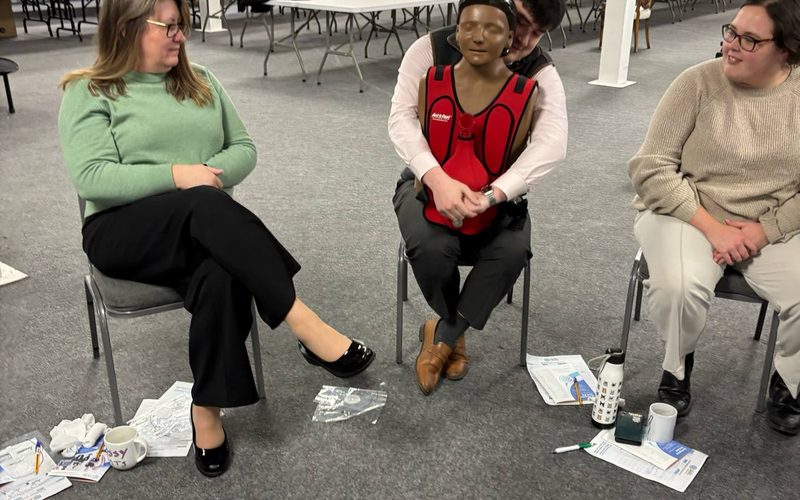
CPR Certificate Course
Focused CPR training for adults, children and infants — ideal for teams who want a shorter, CPR-specific session.
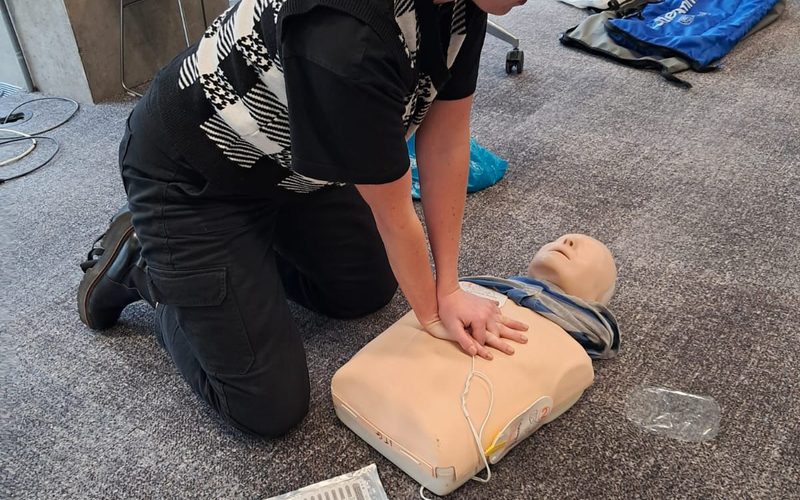
Defibrillator (AED) Training
Learn to use a defibrillator safely and confidently in the critical first minutes of a cardiac event.
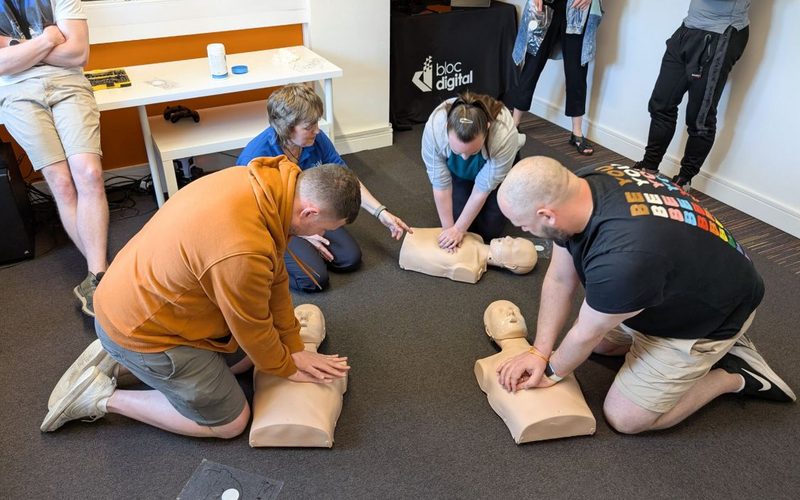
Emergency First Aid at Work (EFAW)
The one-day HSE-compliant first aid qualification for most workplaces — valid three years, FAIB-accredited.
Book Basic Life Support (BLS) training at your workplace
One fixed price for up to 12 people, your location, your schedule. Get a no-obligation quote in minutes or call us to talk it through.