CPR Certificate Course at Your Workplace
Hands-on cardiopulmonary resuscitation training delivered on site, anywhere in the UK. One fixed price for your whole team — no travel costs, no time away from the office.
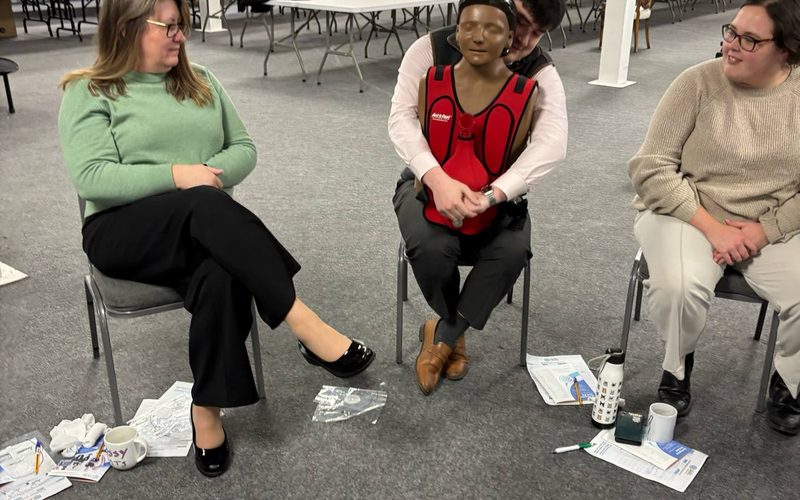
What this course is about
Most people know they should do something in a cardiac emergency — but without hands-on practice, knowing and doing are two very different things. Our CPR Certificate Course on site closes that gap in three hours, without pulling your team out of the building.
The session is built around doing, not watching. Every participant spends substantial time on the manikins — building the muscle memory for correct hand position, compression depth (5–6 cm for adults), rate (100–120 per minute) and full chest recoil. Your experienced instructor guides each person through the technique until they genuinely feel confident, then walks the group through how the steps change for children and infants.
By the time the session ends, everyone in the room will know exactly what to do in the first critical minutes of a cardiac arrest — before an ambulance arrives. That window is what CPR is designed to fill.
Who is this course right for?
This course suits any team that wants broad CPR awareness across a large number of staff — without the time commitment of a full regulated first aid course. No previous training is assumed. Typical bookings come from:
- Office, retail and hospitality teams wanting CPR confidence for all staff, not just nominated first aiders
- Warehouses, logistics and distribution sites running the CPR Certificate Course at your workplace as part of a wider health and safety calendar
- Care homes and healthcare support staff who need annual CPR skills refresh alongside clinical training
- Schools and nurseries giving all teaching assistants and admin staff a resuscitation grounding
- Sports clubs, leisure centres and community groups where cardiac events carry a genuine risk
- First aid certificate holders due for renewal who want a focused CPR top-up between three-year requalifications
If your organisation also needs a regulated HSE workplace first aid qualification, our Emergency First Aid at Work (EFAW) and First Aid at Work (FAW) courses include CPR as part of a full accredited programme.
What your team will learn
The session follows the Resuscitation Council UK's Chain of Survival framework — the four-step sequence that gives someone in cardiac arrest the best chance of survival: early recognition and call for help; early CPR; early defibrillation; post-resuscitation care. Every element of the course maps onto one or more of those links.
Recognising cardiac arrest and calling for help
- Understanding the difference between a cardiac arrest and a heart attack — two very different emergencies requiring different responses
- Recognising the signs: unresponsive, not breathing normally (gasping or no breath at all)
- Calling 999 immediately and following the call handler's instructions while CPR begins
- Managing bystanders — delegating the 999 call, sending for an AED, keeping the area clear
Adult CPR technique
- Correct hand position on the centre of the chest; heel of the hand, fingers interlaced and lifted
- Compression depth of 5–6 cm and full chest recoil between each compression — why both matter
- Rate of 100–120 compressions per minute and how to maintain a steady rhythm without tiring
- Rescue breaths: head tilt, chin lift, pinching the nose and achieving a visible chest rise
- The 30:2 compression-to-breath cycle — and when compression-only CPR is the right choice
- Switching between rescuers smoothly to maintain quality over time
Child and infant CPR
- Key differences for children (aged 1 to puberty): 5 initial rescue breaths before compressions begin, then a 15:2 ratio for trained rescuers
- Key differences for infants (under 1 year): 5 initial rescue breaths, gentle chest compressions with two fingers, infant-neutral airway position (avoid over-extending the neck)
- Why paediatric cardiac arrests are usually caused by a breathing problem rather than a heart problem — and what that means for technique
AED awareness
- How an AED analyses the heart's rhythm and only allows a shock for shockable rhythms (ventricular fibrillation or pulseless ventricular tachycardia)
- Pad placement for adults and children; safety considerations (wet skin, chest hair, implanted devices, medication patches)
- Minimising the pause in chest compressions when attaching pads and delivering a shock
- Continuing CPR immediately after the shock is delivered
How the session runs
Your trainer arrives before the group assembles, sets up manikins and equipment, and is ready to begin on time. There is no projector, no slideshow and no extended theory block at the start. Instead:
- A brief, plain-English introduction explains what a cardiac arrest is, why speed matters and what participants will be able to do by the end
- Participants move quickly into hands-on practice — beginning with adult compressions, then building to rescue breaths, then the full 30:2 cycle
- Child and infant technique follows, with clear demonstrations before each practice round
- AED awareness is woven in, with trainer-unit demonstrations
- The session closes with scenario practice — participants working in pairs or small groups to put everything together in a realistic sequence
- A short Q&A gives everyone the chance to raise anything they are unsure about
Three hours passes quickly when the group is actively engaged. There is no sitting and watching for long stretches — your trainer keeps the pace moving throughout.
Assessment and certificate
There is no written exam. Your trainer observes each participant's technique throughout the session and offers guidance as needed — the assessment is continuous, practical and supportive. Formal failure is extremely rare for anyone who attends fully and engages with the practice rounds.
Each participant who completes the session receives a Certificate of Attendance from First Aid Training On Site. This is an in-house certificate confirming completion of the CPR Certificate Course. It is not a Qualsafe, Ofqual-regulated or FAIB-accredited qualification — certificates from those programmes are issued through our EFAW and FAW courses. Many employers use this certificate as evidence of an annual CPR skills refresh for staff who hold, or are working towards, a regulated first aid certificate.
All manikins, AED trainer units, face shields and printed course materials are supplied by us. You do not need to source or purchase any equipment.
Why deliver this CPR Certificate Course on site?
Sending staff to a public course feels straightforward until you add up the true cost: travel time, mileage or fares, half a day lost per person, the logistical effort of booking individuals onto scattered dates. With our CPR Certificate Course at your workplace, none of that applies.
One fixed price, up to 12 people
At from £395 + VAT for the whole group, the per-head cost falls as low as £33 per person with a full group of 12 — a fraction of the cost of 12 individual public-course places.
No travel time or disruption
Training happens in your building, on a date you choose, scheduled around your shifts and operational needs. Staff are back at their desks the moment the session ends.
Practical for your actual environment
Your trainer can reference your layout, your nearest AED location and your specific team context. That makes the learning directly relevant — not generic.
Fast to arrange
We cover the whole of the UK and can often deliver within a few working days. If a certificate has just lapsed or you need cover ahead of an event, call us on 0800 852 7739 and we will do our best to make it work.
Nothing to source or set up
We arrive with everything: adult and child manikins, AED trainer units, face shields and printed materials. You just need a room, chairs and parking access for your trainer.
Whole team certified together
Everyone completes the session on the same day, so your records stay tidy, your team stays aligned, and no one is missed out because of an awkward public-course date.
Legal and standards context
The Health and Safety (First-Aid) Regulations 1981 require every employer to carry out a first aid needs assessment and provide adequate provision for their workplace. For most employers, that means having at least one person trained to give hands-on first aid — and CPR is a core skill that sits at the heart of any first aid response.
This course is not itself a standalone regulated qualification under those Regulations — it issues an in-house Certificate of Attendance. However, it is widely used as:
- An annual skills refresh for employees who hold a current EFAW or FAW certificate (HSE strongly recommends regular refreshers to maintain skill levels during the three-year certificate period)
- A broad CPR awareness session for the wider workforce, complementing the formal training of nominated first aiders
- A supplementary course for teams that already have regulated first aiders in place and want to extend resuscitation readiness across more of the team
If your needs assessment identifies that you require a formally regulated workplace first aid qualification, our Emergency First Aid at Work (FAIB-accredited, 1 day) and First Aid at Work (FAIB-accredited, 3 days) courses are the appropriate next step. Both are accepted by HSE, Ofsted and most insurers.
Course summary
- Price
- from £395 + VAT (up to 12 people)
- Duration
- 3 hours
- Where
- At your premises, UK-wide
- Accreditation
- In-house certificated
- Certificate
- Certificate of Attendance from First Aid Training On Site
Or call 0800 852 7739
Need a regulated qualification? Our Emergency First Aid at Work course includes CPR as part of a full FAIB-accredited programme — valid 3 years.
Questions about the CPR Certificate Course
Who is this CPR Certificate Course suitable for?
This course is open to everyone — no medical background or prior first aid experience is needed. It is regularly booked for office teams, warehouse and logistics staff, retail and hospitality employees, care home teams, school and nursery staff, sports clubs and community groups. Any workplace that wants broad resuscitation awareness across a large number of staff will benefit, not just nominated first aiders.
What certificate do participants receive?
Each participant who completes the session receives a Certificate of Attendance from First Aid Training On Site. This is an in-house certificate confirming completion of the CPR course. It is not an Ofqual-regulated or FAIB-accredited workplace first aid qualification. Many organisations use it as evidence of an annual CPR skills refresh for staff who hold, or are working towards, a regulated first aid certificate.
Does this course satisfy the Health and Safety (First-Aid) Regulations 1981?
Not as a standalone regulated qualification. The Health and Safety (First-Aid) Regulations 1981 require employers to carry out a first aid needs assessment and provide adequate provision — which, where the assessment identifies the need, means staff holding a regulated EFAW or FAW certificate. This CPR session is ideal as an annual skills refresh or a supplementary course for the wider workforce. For the regulated qualification, see our Emergency First Aid at Work or First Aid at Work courses.
Is a cardiac arrest the same as a heart attack?
No — they are two distinct emergencies. A heart attack is caused by a blockage in a coronary artery; the person is usually conscious, in pain and still breathing. A cardiac arrest is an electrical failure of the heart — the person collapses, becomes unresponsive and stops breathing normally. CPR and a defibrillator (AED) are the immediate treatments for cardiac arrest, not heart attack. Your trainer explains this clearly during the session, along with what to do in each scenario.
How many people can attend one session?
Each session accommodates up to 12 people at the fixed price of from £395 + VAT — so the per-head cost can be as low as £33 per person with a full group. If your team is larger, we can arrange additional sessions on the same day or across consecutive days. Just let us know your numbers when you enquire.
Do you supply all the training equipment?
Yes — we bring everything. Your trainer arrives with adult and child manikins, AED trainer units, face shields and all printed course materials. You just need to provide a clear room with enough floor space for participants to kneel beside a manikin, one chair per person and access to toilets and parking. There is nothing for you to source, hire or set up.
Can the CPR course be combined with AED defibrillator training?
Yes, and it is one of our most popular combinations. A joint CPR and AED defibrillator training session in a single half-day gives your team a complete cardiac arrest response — from recognising collapse and starting compressions through to confidently using the defibrillator. Ask about a combined quote when you get in touch.
How quickly can you arrange on-site CPR training?
We aim to be as flexible as possible and can often deliver within a few working days. If you have an urgent need — for example, a certificate has just lapsed or you need cover ahead of an event — call us on 0800 852 7739 and we will do our best to accommodate you.
What do we need to provide on the day?
Very little. The essentials are:
- A private room large enough for participants to kneel on the floor beside a manikin
- One chair per person and a surface for writing
- Access to toilets
- Parking or loading access for your trainer
A cleared meeting room, a training room or a large open-plan area all work well. We bring every piece of equipment — you do not need to supply anything else.
Related courses
Round out your team's emergency response capability with these complementary courses.
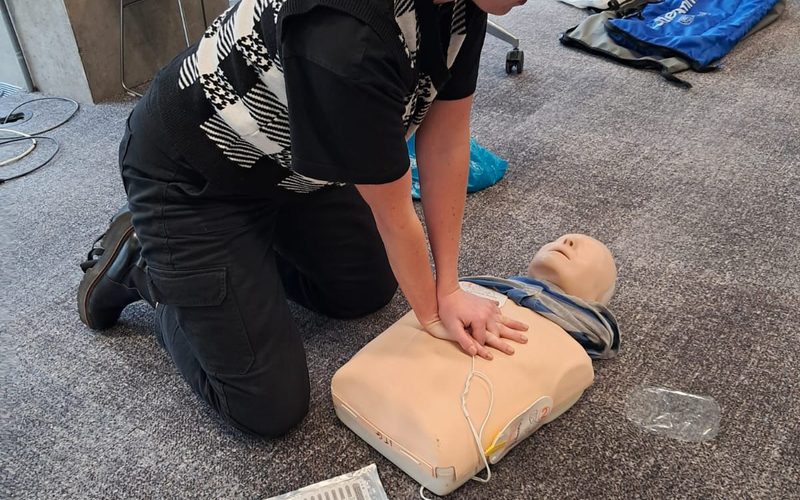
Defibrillator (AED) Training
Confident, safe AED use integrated with CPR — the complete cardiac arrest response.
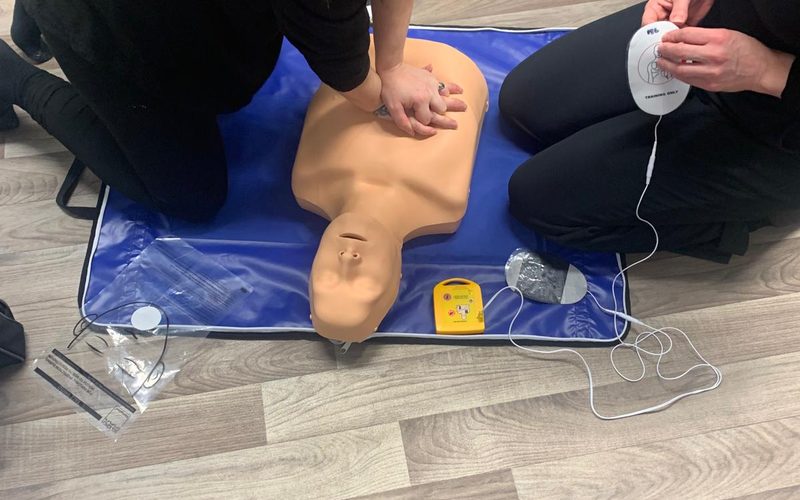
Basic Life Support (BLS)
CPR, airway management, choking and recovery — aligned to Resuscitation Council UK standards.
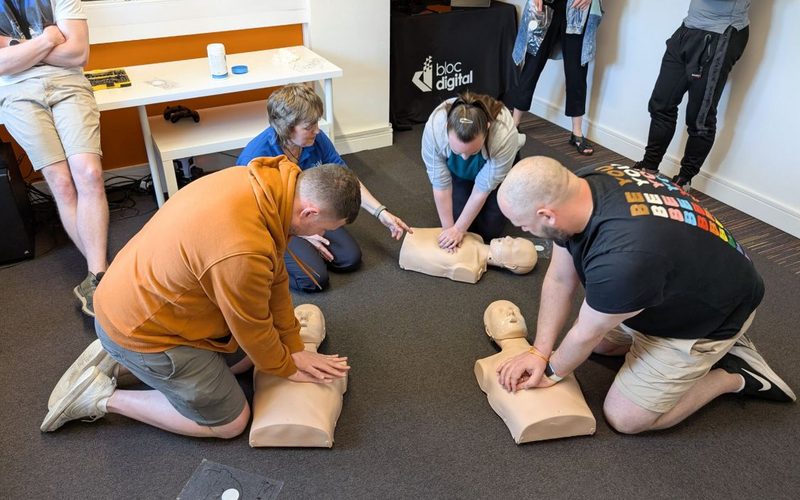
Emergency First Aid at Work (EFAW)
FAIB-accredited, regulated 1-day qualification — includes CPR, AED, choking, bleeding and more.
Ready to book CPR training at your workplace?
One fixed price. Up to 12 people. We bring everything — you choose the date. Trusted by teams across the UK.